
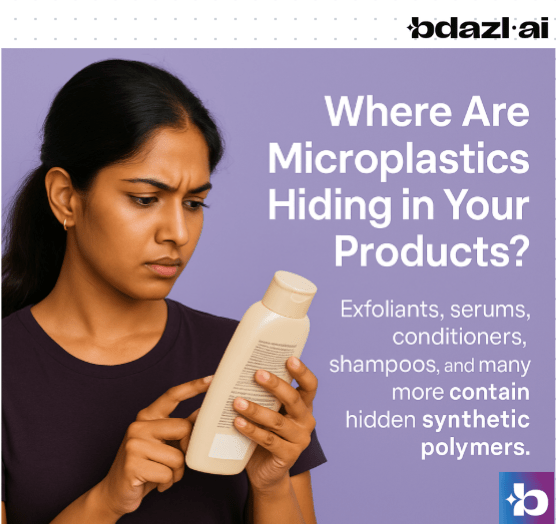
Every day, millions of people indulge in self-care rituals with trust—cleansing, exfoliating, moisturizing, brushing. These moments are meant to enhance well-being. But what if your daily beauty routine is silently polluting the oceans—and your own body?
Unseen and unspoken, microplastics are lurking in products we trust the most. And it’s time to confront this invisible threat—head-on.
Microplastics are microscopic plastic particles, usually less than 5 millimeters. In skincare and haircare, they are used for:
- Exfoliation (like microbeads in scrubs)
- Film-forming (for long wear or frizz control)
- Viscosity control and texture (for creamy, silky feel)
- Binding and stability
Common ingredients include:
Polyethylene (PE), Polypropylene (PP), PET, PMMA, Nylon-12, Acrylates copolymer, Polyurethane, and Polyquaternium compounds.
These ingredients may be small, but they create long-lasting impacts—on your skin, your health, and the environment.
They’re everywhere.
Your exfoliating scrub? Polyethylene beads.
Your anti-frizz conditioner? Polyquaterniums.
That long-lasting lipstick? PET glitter and PMMA.
Even your sunscreen or face mask could contain acrylates.
A single scrub can release up to 300,000 plastic particles. Once rinsed, these bypass filters, pollute oceans, and enter the food chain.
✔️ Barrier Disruption: Microplastics form occlusive films on skin, disrupting transepidermal water loss and barrier function.
✔️ Inflammation: They cause micro-tears, leading to redness, rashes, and irritation.
✔️ Acne & Congestion: Clog pores, leading to blackheads and breakouts.
✔️ Cell Damage: Penetrate compromised skin, accelerate aging.
✔️ Toxic Absorption: Leach additives like flame retardants and phthalates.
Hair & Scalp Impact:
- Hair follicle disruption, potential for thinning and alopecia
- Build-up on strands, leading to dull, heavy hair
- Scalp irritation, dandruff, and microbiome imbalance
- Chlorine/heavy metal interaction in water worsens irritation
Studies have found microplastics in the placenta, amniotic fluid, and even fetal stool.
During pregnancy, skin is more permeable. Leave-on products with PE, PTFE, or acrylates may increase fetal exposure.
📌 Avoid plastic-based cosmetics. Focus on minimal, plant-based routines. Look for “Plastic-Free” certification.
🧴 Cleansing: Use microplastic-free cleansers. Double cleanse gently.
🧴 Barrier Repair: Apply ceramides, niacinamide, centella, and panthenol.
🧴 Hydration: Use hyaluronic acid, glycerin, and occlusive moisturizers.
🧴 Scalp Detox: Clarifying shampoos, ACV rinses, clay masks.
🧴 Deep Conditioning: Natural oils (coconut, argan), protein treatments.
🧴 Anti-inflammatory Care: Aloe, tea tree, oatmeal preparations.
Internal detox support: Hydrate, eat antioxidant-rich foods, consider supplements like glutathione, NAC, and milk thistle.
Words like “natural,” “eco-friendly,” or “clean” are not regulated.
These often still contain plastic polymers under names like:
- Polyethylene (PE)
- PMMA (Polymethyl Methacrylate)
- Polyquaternium
- Acrylates copolymer
- PTFE (Teflon)
📌 If it ends in “-polymer” or “-methacrylate,” be suspicious.
Use tools like Bdazlai to scan and decode ingredient lists.
🌍 EU: Enforcing bans across product categories under REACH.
USA: Banned microbeads in rinse-offs only. Leave-ons still allowed.
India: Proposed bans but many brands still use PE & PQ compounds.
Brands are slowly self-regulating. Consumers must lead the demand.
✔️ Read INCI labels: Learn to spot microplastics.
✔️ Use trusted tools: Like Beat the Microbead or Bdazlai AI scanner.
✔️ Choose certified brands: “Zero Plastic Inside” certified.
✔️ Switch to natural alternatives:
- Exfoliants: Jojoba beads, sugar, salt
- Moisturizers: Shea, aloe, oils
- Haircare: Coconut oil, flaxseed gel, herbal rinses
Try DIY masks, scrubs, and oils for simple, plastic-free care.
This isn’t just about marine life. It’s your face, your scalp, your future.
Microplastics are everywhere. In your bathroom. In your blood. In your baby.
But you have the power to stop them. One label at a time. One conscious choice at a time.
💬 Final Thoughts from bdazlai
Microplastics are not just an environmental problem—they’re a health crisis hiding in your vanity. What seems like a simple scrub, serum, or shampoo may be leaving a lasting impact on your skin, body, and the planet.
At bdazlai, we help you see beyond the marketing.
Our AI engine helps decode ingredients and build safer routines for every stage of life.
Because personal care should never be harmful.
💜 bdazlai – Make it Personal.


Leave a comment